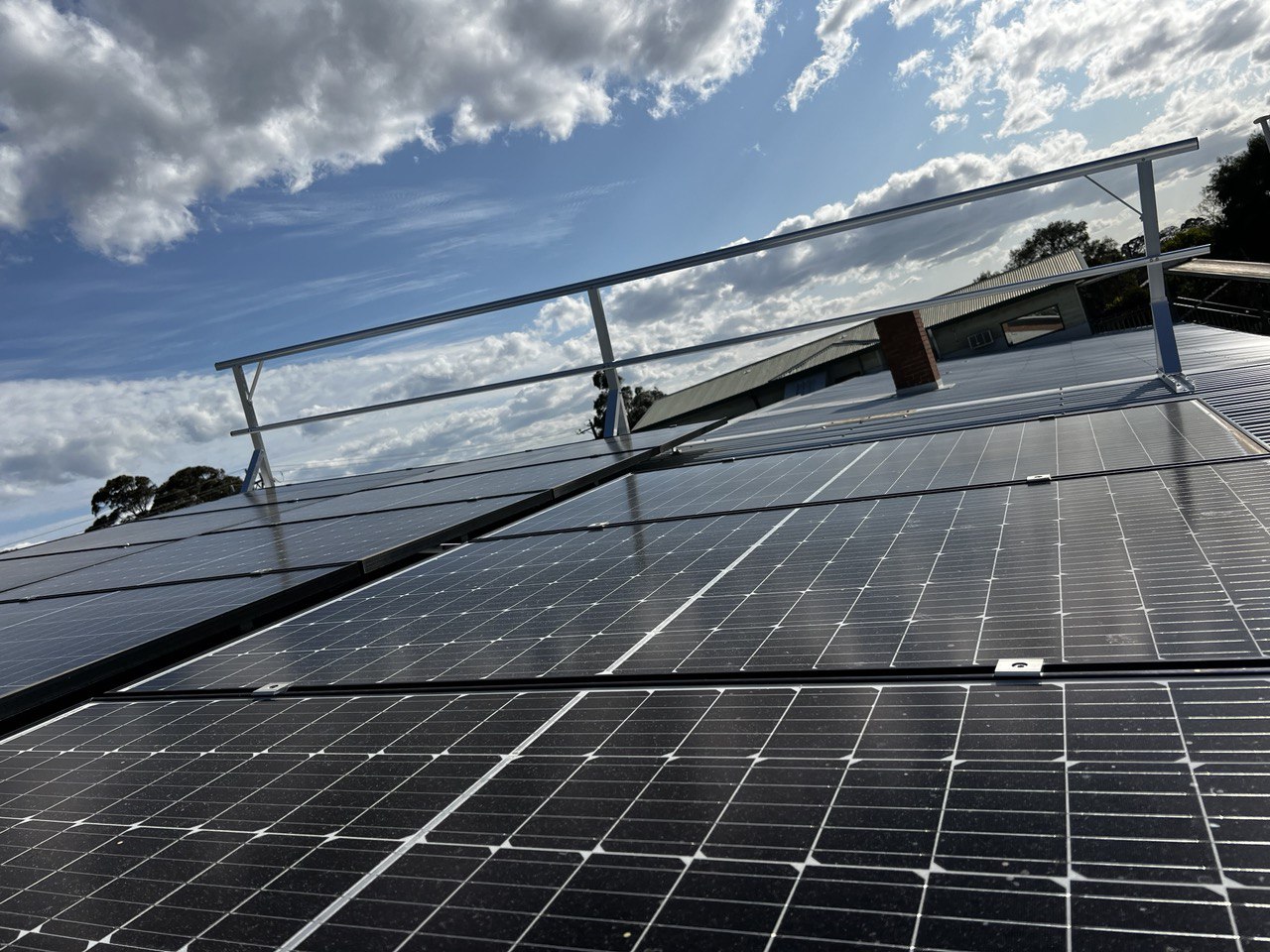
Thousands of Victorian schools now have solar panels on their roofs, and most have a compliance gap they don't know about. Once panels are installed, someone eventually has to go up and service them, and your height safety systems need to cover where they will be working.
The Compliance Gap No One Talks About
When schools install solar panels, the focus is on the panels themselves — the output, the savings, the installation process. What rarely gets discussed is what happens two or three years later when those panels need cleaning, inspection or repair.
Solar panel maintenance contractors need to access your roof. Under Victorian OHS legislation and the relevant Australian Standards, anyone working at height on your premises must have access to compliant fall protection. As the employer and the party that manages and controls the site (sections 21 and 26 of the OHS Act 2004), the school is responsible for ensuring that compliant systems are in place.
If you allow a contractor to access your roof to service solar panels and there are no compliant anchor points or guardrails in place, you are exposed. It doesn't matter that the contractor brought their own equipment — the obligation to provide a safe working environment sits with the school.
The key question to ask
When was the last time your height safety systems were inspected — and do they provide adequate coverage for where solar panel maintenance contractors actually need to work on your roof?
What Solar Panel Installations Often Miss
Solar panel installers are not height safety specialists. Their job is to install panels, not to assess or provide fall protection systems for future maintenance access. In our experience working across Victorian schools, we regularly find:
- Solar panels installed on sections of rooftop not covered by existing anchor points
- No compliant access route to reach panels — contractors are expected to improvise
- Fragile roof sheeting (asbestos cement or fibreglass) beneath or adjacent to panels with no protection or signage
- Existing anchor points that were adequate for gutter cleaning but don't provide coverage for the areas where panels were installed
- No guardrails at the roof edge where maintenance work occurs
Each of these represents a compliance gap — and a potential liability for the school.
What Compliant Solar Panel Maintenance Access Looks Like
For a school rooftop with solar panels to be compliant for maintenance access, you need a system that:
- Provides a safe, compliant route from ground level to the roof — typically a fixed ladder, walkway or hatch built to AS 1657:2018
- Covers all areas of the roof where maintenance contractors need to work, including the panel arrays themselves
- Protects workers from falls at the roof edge and from fragile roof sections
- Is inspected at least every 12 months in accordance with AS/NZS 1891.4, with anchors that meet AS/NZS 5532:2013
Depending on your rooftop configuration, this might mean installing additional anchor points in the panel areas, a perimeter guardrail system, safety mesh over fragile sections, or a combination of all three.
Fragile Roof Sheeting: An Extra Layer of Risk
Many older Victorian school buildings — particularly those built before the 1980s — have asbestos cement or fibreglass roof sheeting that has become brittle over time. These roofs are a serious hazard for any contractor walking on them, and the risk is compounded when solar panels are installed because workers need to navigate around them.
Where fragile roof sheeting is present, roof safety mesh to AS/NZS 4389:2015 and clearly visible danger signage are required in addition to the height safety systems covering the roof edge. This is a specific obligation that often gets missed entirely when solar panels are the focus.
We've seen this across Victoria
We regularly audit school rooftops where solar panels have been installed without any corresponding height safety upgrade. In most cases, the solution is straightforward — additional anchor points, edge protection or safety mesh — and the cost is far less than the liability exposure of leaving the gap unaddressed. Book a compliance audit for your school →
What to Do If You're Not Sure
If your school has solar panels and you're not certain whether your height safety systems adequately cover maintenance access, the right first step is a compliance audit. An experienced height safety inspector will assess your rooftop, identify any gaps in your existing systems, and provide a written report with recommendations.
This gives you a documented record that you've taken reasonable steps to identify the risk — which matters if WorkSafe ever comes knocking — and a clear scope of works if upgrades are required.
Don't wait for a solar maintenance contractor to point out that your roof isn't safe to access. By then, either the work has already been done unsafely, or you've had to turn the contractor away and your panels aren't being maintained. Neither outcome is good.
Standards and legislation referenced
- Occupational Health and Safety Act 2004 (Vic): section 21 (employer duty, which extends to contractors on matters the employer controls), section 23 (duty to people other than employees) and section 26 (duty of anyone who manages or controls a workplace).
- Occupational Health and Safety Regulations 2017 (Vic), Part 3.3 Prevention of falls: applies where there is a risk of a fall of more than 2 metres and sets the order of controls, from working on the ground, to passive fall prevention (guardrails), to work positioning and fall arrest systems.
- AS/NZS 1891.4 Industrial fall-arrest systems and devices, Part 4: Selection, use and maintenance. Sets inspection intervals of no more than 12 months for anchorages and lifelines, and no more than 6 months for harnesses, lanyards and connectors.
- AS/NZS 5532:2013 Manufacturing requirements for single-point anchor devices used for harness-based work at height. Single-person anchors are rated to 15 kN.
- AS 1657:2018 Fixed platforms, walkways, stairways and ladders, including permanent roof access ladders and guardrails.
- AS/NZS 4389:2015 Roof safety mesh, used under or over fragile roof sheeting.
Last reviewed 27 September 2026 by O'Brien Height Safety Solutions. General guidance only, not legal advice. Check your specific site with a competent height safety inspector.